
Luka Bloom



Releases
Eleven Songs
the release of his new album Eleven Songs on Bar/None Records on March 10th. Eleven Songs is his eleventh album and it is a return to the bold production work of his early critically acclaimed Warner Bros. releases 1990’s major label debut Riverside and 1991’s The Acoustic Motorbike. In the interim he has continued to work up innovative approaches to solo acoustic guitar and his voice has developed an incredible range that rolls from deep bass tones to soaring falsetto.
Social Media
For Eleven Songs, which Luka co-produced, recorded and mixed with original Frames’ guitarist David Odlum, he has written a classic batch of songs including the catchy country folk of “On Your Side” and the poignant tour de force “Don’t Be Afraid of the Light That Shines Within You.” The record features Luka on a number of different guitars with tasteful backup that includes stand up bass and drums on some tracks and strings and a choir on others but is always centered with Luka’s voice and guitar.
In November 2007, Luka sat down with Odlum to discuss the 20 songs he had to consider for his the next record. Says Luka, “As well as a gifted and patient and creative engineer, David has great music in him, having been The Frames guitarist for many years. I felt we could make a great record together. We both agreed I needed to push the boundaries a lot more. These songs seemed to demand I move away from my comfort zone, and go to a large studio, to make a more traditional style record; great room, great musicians and singers, old microphones.”
“We wanted to capture an honest, and hopefully beautiful performance of the songs,” continues Luka. He admits being influenced by the Allison Krauss / Robert Plant album Raising Sand. “It seemed like a long time since I had heard such a raw, beautiful room sound. And we both thought, lets try to record the songs this way. It’s a simple formula, but quite rare these days; partly because it is really expensive, compared to the laptop in the bedroom records which are so common now.”
The album was recorded at Grouse Lodge in County Westmeath. “We sang and played and laughed, and ate like kings.” Luka continues, “During that time we were joined by Dave Hingerty (ex-The Frames), drums; Trevor Hutchinson, double bass, Liam O'Maonlai (ex-Hothouse Flowers) and Paul Smith on pianos. Liam also played harp on one song and sang. Joe Csibi brought a string quartet from Dublin. Kenneth Edge came down with soprano sax and clarinet. Sinead Martin came and sang with me. Conor Byrne played some flute. By the time we left Grouse Lodge 20 songs became 15, and we knew we were on to something good. Over the next few weeks we added some vocals from Robbie Moore, as well as a visit to the Gospel choir in Gardiner Street. Aoife Tunney was recorded for Everyman. Joshua Grange emailed us a pedal steel part from Los Angeles. And suddenly we were done by mid May, so off we went to Black Box again, and over 10 days, 15 songs became 11. We were done and we were, and are, very happy.”
The press in Ireland has been enthusiastic about Eleven Songs’ release. Hot Press proclaimed, “Bloom is nothing if not consistent. This is his 11th solo album in a career that stretches back over 30 years and he hasn’t made as duff record yet…it is warm and sepia-toned…The predominant theme is a spiritual one, encompassing love and loss: the crunch track is the wonderfully optimistic ‘Don’t Be Afraid of The Light That Shines Within You.’ Reminiscent of Astral Weeks-era, Van Morrison meets U2’s ‘I Still Haven’t Found What I’m Looking For.’ It boasts soaring string and the massed voices of Gardiner Street Gospel Choir – a superb synthesis. All told 11 Songs is an album that reveals a superb craftsman working at the top of his game. Savour it.”
Eleven Songs’ stellar track “Don’t Be Afraid of The Light That Shines Within You” expresses Luka’s feelings at the beginning of 2009 and honors the yearly feast on February 1st in his hometown of Kildare, Ireland when groups of people gather to welcome the beginning of Spring and celebrate Brigid, the Patron Saint of Kildare who was the goddess of love, poetry and justice in pre-Christian Ireland. Luka says, “Every year we gather to welcome the light into our world; and to hope that more light will shine in the world; and that someday out of the darkness of war, hunger, greed, poverty, will come the light of community, sharing, justice, music, dance, peace and love. I wanted to write a simple song to share with everyone in Kildare, and light a spark for change. He wrote the song around 2000 and for years only sang it in Kildare, but in 2008 he felt a surge of energy around this song and recorded it for Eleven Songs. Luka continues, “This song is my prayer for the world, and I send it out at the start of this exciting and dangerous year, with love and hope in my heart for our shared future. Songs can also be prayers, blessings, and they can be a spark to ignite something beautiful in anybody. January 2009 could mark a great beginning. I hope it is”
The critical praise for Eleven Songs also included a “4 Star” rave in The Irish Times. “…he's sizzling like a neophyte who's just discovered the magic in a newly minted song. Sure, there are traces of Bloom's trademark percussive guitar style and his political instinct on Fire, but the rest is a highly personal journey: fingering stillness and, most of all, what it means to live comfortably in one's own skin. Acoustically, Bloom has created a space that serves his meditations well….this is a collection that doesn't so much assault the senses as infiltrate them, lingering long after the final note has sounded. A quietly triumphant return to his roots.”
Returning to the raw live sound of his earlier records and brimming with inspiring lyrics and sumptuous melodies, Eleven Songs reminds us why Luka is such a master of the concert stage and you can hear the pleasure that was had by all the participants in the album’s perfect grooves.
Before Sleep Comes
Before Sleep Comes is chill-out music for the soul. Irish singer-songwriter Luka Bloom created this intimate album specifically for late night listening, for those last moments of wakefulness when the imagination remains fertile but the flesh is often worn out. Its purpose, he explains, ""is to bring you closer to sleep, our sometimes elusive night-friend."" But Luka may have thwarted his stated purpose: he performs elegantly austere new songs and covers traditional ballads in such a quietly compelling manner that one would find it almost impossible to drift off while these gorgeous grownup lullabies are spinning.
It was in the early months of 2003 that fate, not design, pushed Luka away from his signature style -- the high-energy, quick-handed attack he took on his steel-string guitar -- towards a more contemplative approach on a nylon-stringed instrument. A bout of tendonitis in his right hand, a recurring ailment, had seriously sidelined him, making it painful to do gigs or even write songs. While being treated by a physical therapist, he picked up his Spanish guitar and gingerly started to pick. As Luka explains, ""After a few weeks of really soft playing, I became fond of it, and began to feel very relaxed with this style of playing, almost non-playing. I began to play ballads, and soon found myself singing and writing whispery songs. I was doing this daily, and by August, I realized that this needed to be recorded.""
Luka completed Before Sleep Comes over the course of two windy nights in autumn 03 at the Old Mill, a lovely, off-the-beaten-path studio near Naas, County Kildare. He¹d previously cut most of his 1999 Salty Heaven there, the most elaborate production Luka had undertaken in his then decade-old recording career. This time was dramatically different: just Luka¹s bedroom-volume voice, his Spanish guitar and his midnight confessions, all captured in the wee small hours.
""Rarely does quietude translate so powerfully on record,"" said Irish Times critic Siobhan Long in a four-star review, ""and rarer still is the bottling of an artist's personal happiness as successful as this beautifully somnambulant albumŠ Luka fuels this gentle mix of original and traditional tunes (including a finely understated reading of The Water is Wide and an even finer snapshot of the twilight zone that is the title track) with minimum intervention beyond strings and larynx. One for the witching hour. "" The Irish Voice simply declared, ""It feels like Luka has made a record just for your nightstand.""
Before Sleep Comes is not so much a radical change for Luka as a deeper exploration of a particular aspect of his craft. He¹s long been known for creating rousing, anthemic tracks like ""The Acoustic Motorbike,"" ""Delirious"" and ""Perfect Groove"" that bring crowds to their feet at his concerts. But Luka has been equally adept at composing romantic slow-burners -- like ""True Blue,"" ""Don't Be So Hard on Yourself"" and ""Love is a Place I Dream Of."" Evocative new after-hours tunes like ""Camomile,"" ""She Sings Her Songs With Open Eyes"" and ""Before Sleep Comes"" will surely come to rank with the best of Luka¹s balladry.
This is Luka's third album with Bar/None. Between the Mountains and the Moon, released in 2002, showed Luka stretching as both vocalist and writer on an ambitious set of original material that dealt with matters both sensual and spiritual. Keeper of the Flame, from 2001, featured ingeniously arranged covers of songs that had inspired Luka over the years, including Bob Dylan's "To Make Me Feel Your Love," the Cure's "In Between Days" and even ABBA's "Dancing Queen."
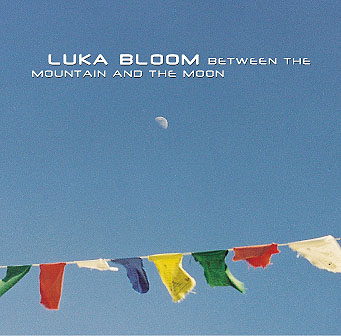
Between the Mountain and the Moon
Luka Bloom's sixth album, Between the Mountain and the Moon, is his first collection of new, original material since Salty Heaven, released in the U.S. in 1999. Not that Luka has left his fans wanting. In between, he managed to put together Keeper of the Flame, a highly personal homage to his favorite classic and contemporary songwriters, and he also found time to tour the world, playing to sold-out crowds in Australia, the U.S., his native Ireland, and continental Europe, while road-testing the tunes that would make up this gorgeous new set.
Luka has truly lived with this material, refining it on tour and gently polishing it to perfection in the studio. Although the process took almost two years, the songs show no signs of wear and tear; Between the Mountain and the Moonsounds like one seamless session, intimate, impassioned, and musically, lyrically, and thematically unified, an album in the classic sense. While Luka was concentrating on the cover songs he radically retooled for Keeper of the Flame, he said he learned "to trust myself more as a singer." And it shows here he fearlessly stretches himself vocally, as well as instrumentally, especially on tracks like the otherworldly "Gabriel" and the hushed "Moonslide," which he delivers in a beguiling bedroom whisper.
Most importantly, Luka has learned how to enjoy life in the recording studio. He's always been comfortable on a stage with just himself, a couple of guitars, and maybe a vase of flowers. The challenge for him in making records has been how to capture both the exuberance and the intensity of his performances. Luka has tried various approaches, from the stunning, live-in-the-studio simplicity of Turf in 1994 to the lush, labored-over orchestrations of Salty Heaven. He channeled New York City edginess to make his 1990 in-your-face debut, Riverside, then went to the emerging bohemia of Dublin's Temple Bar in 1991 to create Acoustic Motorbike, importing Manhattan musicians to mix up it up with some of the coolest locals.
Despite his innovative tactics, Luka was never quite satisfied. Until now. "This is the first time I felt confident in a studio," he confesses. "I've finally found a relationship with a studio and an engineer, where I feel capable of expressing myself without (too much) fear."
The studio is the legendary Windmill Lane in Dublin, where everyone from U2 to the Rolling Stones has recorded. The engineer is Brian Masterson, a veteran of sessions with the Chieftains, Van Morrison, Altan, and the Corrs, among many others, who first worked with Luka on Turf, bravely allowing him to bring a potentially unruly live audience into the studio for a handful of evenings. Brian subsequently co-produced Keeper of the Flame; those sessions resulted in arrangements of well-known songs that were as unexpected as they were austere.
"I began recording some songs in September 1999, did a week or so in Windmill, maybe nine songs," explains Luka, recalling the beginnings of Between the Mountain and the Moon. "No plan, no rush. Then in 2000, I decided to make a CD of other artists, songs and recorded Keeper of the Flame. Every now and then I'd quietly slip into the studio and do a day or two with some of these songs. Little by little, the songs took shape, different musicians coming in to play, all very relaxed, no pressure. Right up to the end I kept my mind open for new songs and for new ideas. Each person who plays on this CD brought something very special to the songs. Almost every note people performed remains in the mix. Every session was essential, and something beautiful happened each time. "
Between the Mountain and the Moon is a collaboration among several musicians, including Luka's gifted nephew Connor Byrne, a flautist and recording artist in his own right who accompanied Luka on Salty Heaven. For many, perhaps the most noteworthy participant will be Sinead O'Connor, a significant but last-minute addition to the lineup, who came in to lend her voice to one track but, following the free-form spirit of the project, stuck around to contribute subtle but stirring vocals to a few more. As Luka told an Australian reporter, "The record was finished and I was listening to the songs and I thought, 'God, wouldn't it be great if Sinead could sing on this.' I happened to have her number, and I phoned her to ask if she'd do it, and she said, 'OK.' It's not always possible to take the direct route, but I was lucky with Sinead! To have her on the record is quite a blessing for me."
He was also lucky to find a room to record in that felt more like a second home than a utilitarian studio, a place where he felt he belonged. "It's a beautiful room to sing in," he reveals. "If you listen to some old jazz records, like Sinatra or Ella Fitzgerald, you can hear the drums, the bass, and the brass. You can hear the session. You can hear the room. That's the reason why Windmill Lane is important to me, because you can capture the sense of people performing."
Luka's Australian fans got a jump on their compatriots in other countries because Luka decided to release the album there in late 2001, in anticipation of an early '02 down-under tour. (Look for Luka to arrive in America in the late spring.) The critical response has been overwhelmingly enthusiastic, a harbinger of things to come around the rest of the globe. A reporter for the Sydney Morning Herald called Between the Mountain and the Moon "arguably the best and most coherent album Bloom has ever produced." "A starkly beautiful recording," declared a critic from the Herald Sun. And a writer for The Green Guide rhapsodically described it as "a majestically romantic collection of ballads that, from the opening paean to love, 'Monsoon', just sweeps you along on its powerful, poetic current."
Love is definitely on Luka's mind here, be it sensual ("Monsoon") or spiritual ("Gabriel"). But Between the Mountain and the Moon is about more than that. It's about playful pride for a home and a heritage ("I'm A Bogman"), the courage of commitment to faith ("Shoshin," dedicated to Maura O'Halloran, an Irish-American woman who became a Zen Buddhist monk in Japan) or to a cause ("Love is a Place I Dream Of," dedicated to Christina Noble, a Dubliner who has devoted her life to sheltering homeless children). It's about extraordinary characters in an exotic land ("As I Waved Goodbye," inspired by the book Seven Years in Tibet) and humble heroes in a more familiar setting ("Hands of a Farmer," a tribute to County Clare singer and storyteller Micho Russell). Finally, it's about the simple pleasures of picking up the guitar ("Perfect Groove") and those moments when everything just feels right ("Rainbow Day").
Between the Mountains and the Moonis full of moments when everything just feels right. It's Luka Bloom's most mature work, yet it's as fresh as his decade-old debut, a soulful, occasionally joyful, consistently moving album that was definitely worth the wait.
Keeper of the Flame
"I decided to use this project to celebrate the work of artists I love," Luka Bloom explains. "This was the decision that caused me to get fired up about the CD: the idea of taking songs that are already loved, by artists who are already loved, and presenting them in a unique musical environment. Some of this was about interpreting songs I already knew and felt comfortable with. Some of it was about challenging myself to perform songs that supposedly come from outside my area, from artists like the Cure, U2, Radiohead, and Abba.
"Rather than covering these songs as a novelty, I was determined to convey my love of these songs and the artists who created them. So much music is producer-driven and intensely layered; often it’s a journey to get to the core of a song. The song is the flame to me, and in presenting these songs in a simple way, I want to be a keeper of the flame."
Luka has already won the approval of European and Australian critics and fans for Keeper of the Flame; the album has received an especially warm reception in his native Ireland. For the U.S. edition, Luka has added a track exclusively for this territory, a moving rendition of Robbie Robertson’s "Golden Feather." The packaging has been updated too, and it features photographs, including the cover image, not available on import versions.
Keeper of the Flame is about transformation, not simply interpretation. And that’s what Luka’s career has always been about. After all, it was about a dozen years ago that he transformed himself, on a flight from Dublin to Washington D.C., from a singer-songwriter named Barry Moore to an itinerant ex-pat troubadour named Luka Bloom. With a new name and a new, albeit temporary, home, he built a reputation and a fan base, while commuting via train between D.C. and New York City. He attracted major-label interest and signed a deal with Warner Bros/Reprise Records that yielded three highly acclaimed albums -- Riverside, Acoustic Motorbike, and Turf -- and performed his music around the world. When he eventually returned to Ireland, he was something of a star. He had been transformed.
His audiences learned that Luka was also able to transform the cover material he occasionally performed. He chose his covers sparingly but wisely, performing an anthemic, clamored-for version of the Waterboys’ "This Is The Sea" and a delicate rendition of Sam Phillips’ little known gem, "River Of Love" -- and sometimes he blended the two into a suite of songs that built to an almost religious intensity. Then there was his startling reworking of L.L. Cool J’s rap classic, "I Need Love," in which sexy, streetwise come-ons set to break beats were turned into romantic bedroom balladry for acoustic guitar, bodhran, and fiddle. This iconoclastic take on "I Need Love" helped make Acoustic Motorbike one of his most perennially popular releases. He covered Elvis on that one too, with a gentle rendition of "I Can’t Help Falling In Love With You."
Luka has toyed with other tunes on the concert stage since then: a fiesty version of Prince’s "When Doves Cry," a stunning, straightforward rendering of "Everybody Hurts" well before the Corrs appropriated it. But except for a brooding version of the traditional ballad "Black Is The Color" and "Sunny Sailor Boy," a never-before-recorded Mike Scott song that Mike personally gave to Luka, none of Luka’s covers have made it to disc. What he has done now is a rare achievement: Luka has created something entirely original from found materials. Keeper of the Flame is as personal and revealing as any of his previous, self-penned albums: an intimate glimpse into the heart and the mind of an unfailingly honest artist.
Luka’s previous album, Salty Heaven, was a relatively lush affair that spotlighted his increasingly expressive vocals in beautiful settings. Keeper of the Flame is a return to an austerity that, in its way, is equally impressive. Luka co-produced the album at Windmill Lane with engineer Brian Masterson, returning to the environment where the pair had so successfully captured the essence of Luka’s live performances with Turf six years before and taking the same mostly solo approach. There were some special guests, however, including Luka’s brother Christy Moore on bodhran, flautist Conor Byrne, and fiddle player Nollaig Casey, all of whom leave their own indelible mark on this material.
Some of these tracks contain songs that Luka seemed destined to do, like Joni Mitchell’s "Urge For Going" or Bob Marley’s "Natural Mystic," which echoes Luka’s own concert favorite, "The Fertile Rock." Others, like the Cure’s "In Between Days" and Radiohead’s "No Surprises," seem utterly unlikely, yet Luka makes them his own. He turns the R&B classic "Wishing on a Star" into a gentle ballad and reshapes "Dancing Queen" into something sweetly celebratory. The A-Teens can keep their synthesized Abba concoctions; this one is for the grownups -- and be sure to hold on to your partner while you’re dancing.
Tim Hardin’s "If I Were A Carpenter" would seem like standard-issue repertoire for any acoustic guitarist with an ear for a great folk tune. But Luka breathes new life into the song with a particularly stirring vocal performance that proves his singing has become just as eloquent as his guitar playing.
"An unexpected side effect of this CD is I felt liberated as a singer," Luka reveals. "I think I felt a sense of responsibility to really try to do justice to the songs. Yet I was also freed from any self-consciousness because I was articulating the experience of other people. This is new territory for me. I’ve done covers before, but never in this singular, focused way. I hope that the love comes through."
Among his greatest challenges was tackling "BAD," one of U2’s signature songs. But Luka brought his own emotions to the track, feelings resurrected from his earliest days in America, after he had just left Barry Moore behind. Perhaps that’s what makes his version of "BAD" so affecting.
As Luka explains: "It was winter, 1988. Do the gig at the Red Lion in Greenwich Village and decide to take the night train back to D.C. I’m in Penn Station at one a.m. It’s a very sad and scary scene there -- many walking wounded, cold, huddled, mumbling casualties. By the time the train pulls in, I’m in a dark place inside. I sit on the train and take out my walkman. As the train pulls out of Penn, I stumble across a radio station, the opening notes of the Edge’s intro ease into my ears, and I instantly feel connected to something serene and beautiful. I leave the New York skyline to the sound of ‘Let it go, and so to fade away...’ Somehow, all was well in the world again. I was meant to hear this song, in this way, at this moment. And so it is one of my very favorite songs of all time. I could never have imagined that 12 years later I’d be singing it, celebrating it, passing it on."
In that instant, Luka Bloom was transformed by a song. Put on Keeper Of The Flame and that may happen to you, too.
-Michael Hill